For years, the standard critique of carbon markets in Africa has been simple: the money never seems to reach the people doing the actual work. Last week, South Africa produced a counterexample. The Grassland Restoration and Stewardship in South Africa Group Project (GRASS GP) — led by carbon project developer TASC with Meat Naturally Africa — delivered its first carbon credit payments: R2.7 million (about $170,000) to 15 farming communities in the Eastern Cape and KwaZulu-Natal, as reported by Carbon Herald.
It is a modest cheque by global carbon market standards. It is also one of the most important signals African producers have received all year — because of who got paid, and how.
What actually happened
- 266,254 verified carbon units were issued for the project's first monitoring period — generated by restoring degraded rangelands through regenerative grazing, improved livestock management, and land stewardship.
- The project spans over 95,000 hectares, roughly 180 communities, and nearly 10,000 livestock farmers.
- The credits are the first in the world to combine CCB certification with Verra's VM0042 methodology — a stamp that the climate, community, and biodiversity impact is all independently verified.
- Revenue flows to communities through their own grazing associations, funding herders, fire control, veterinary care, and pasture restoration.
And the carbon money is not even the biggest number in the story. Better market access built around the project — mobile livestock auctions, wool-shearing services — has already generated roughly R56.4 million (~$3.5 million) in additional income for participating farmers.
The design choice that matters
Most environmental finance treats local communities as beneficiaries: a project happens around them, and some share of value trickles down. GRASS inverted that. Communities are contracted partners, their share of net revenues is designed to exceed 50% within the first ten years and reach up to 80% by year twenty, and hundreds of residents have been trained as "Ecorangers" — paid land managers running the pasture monitoring, fire prevention, and invasive species control themselves.
As TASC Africa CEO Shelley Estcourt put it: carbon credits are often discussed in terms of tonnes and markets, but their long-term value depends on creating durable economic opportunities for the people who make the projects possible.
Why this matters beyond grasslands
We work on a different removal pathway — turning agricultural residues into biochar — but the GRASS payouts validate the exact model we believe in for African carbon:
- Verification pays. These were not promises or pre-sales; the money followed a registered project issuing independently verified units. High-integrity paperwork is what turned grass into revenue.
- Stacked certification commands trust. The world-first CCB + VM0042 combination exists because buyers now pay for proof of community and biodiversity impact, not just tonnes. The same logic is lifting prices for durable removal credits like biochar.
- The producer share is the headline. A model where the people supplying the land — or, in our case, the residues — capture the majority of value over time is what makes these projects durable for 20+ years.
- Infrastructure is arriving to meet supply. With Kenya building a national registry and a regional exchange, and South Africa now demonstrating verified payouts on the ground, the African carbon market is growing both its plumbing and its proof points at once.
The takeaway
GRASS plans to restore two million hectares by 2030, preventing an estimated 14 million tonnes of CO2 emissions over 30 years. But the number that should stick with every agro-processor and landholder reading this is smaller: R2.7 million, paid, in bank accounts, for land stewardship that was independently verified. Carbon finance reaching African producers is no longer a thesis. It is a payment record — and the producers who get registered, certified, and verified now are the ones who will be on the next one.
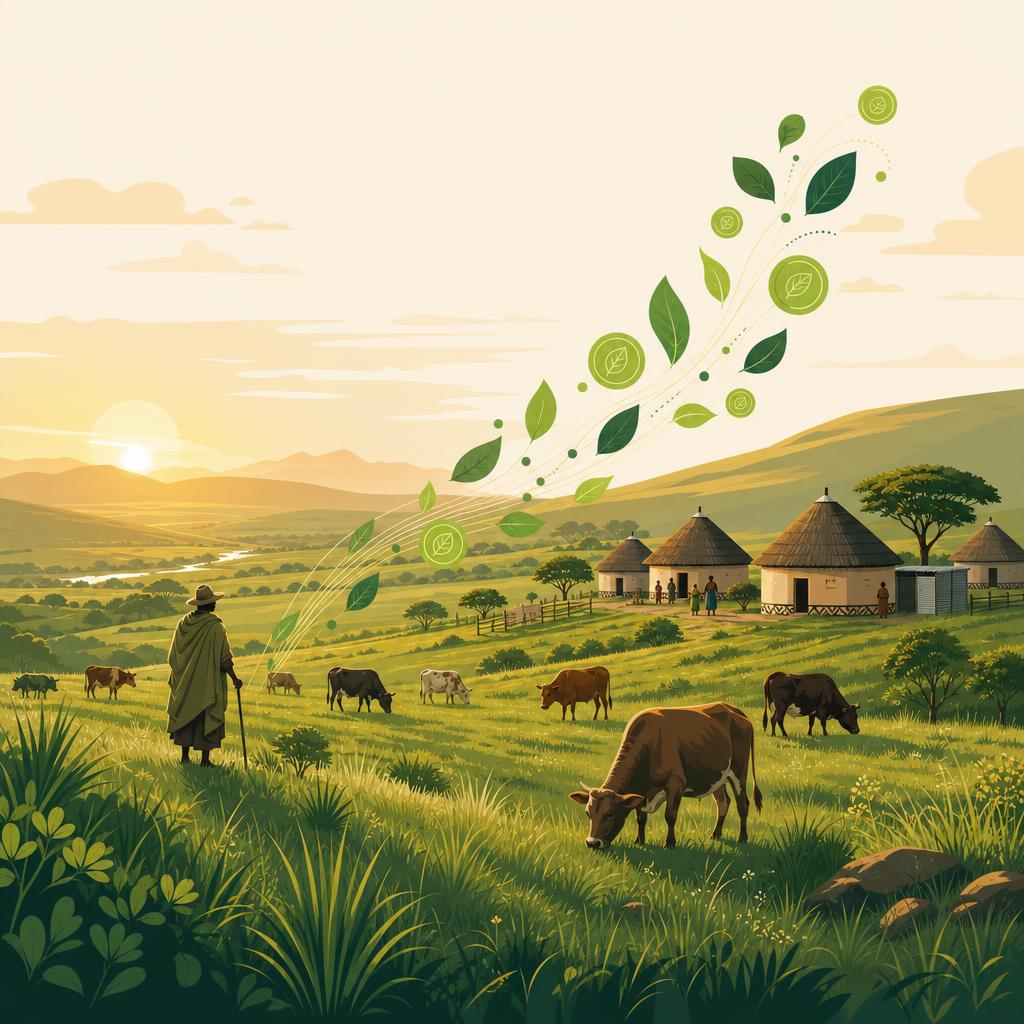
Source: Carbon Herald (August 7, 2026), South Africa Farmers Receive First Carbon Credit Payouts, by Marieta Dimitrova. Illustration is BIG's own.